Technologies
Job hunting is a volume game that punishes volume. The more roles you apply to, the harder it gets to tailor each application — and the moment you stop tailoring, your response rate drops. Most candidates end up choosing between quality and scale. They shouldn't have to.
Job Fit Analyser is an AI tool that reads a job description and tells you exactly how well your profile fits — and more importantly, where the gaps are and what to do about them.
The problem it solves
A job description is a signal, not just a checklist. It tells you what the hiring team actually cares about, what language they use, what they're optimising for. Most candidates skim it, decide they're a fit based on the title, and send a generic application. That's why most applications go nowhere.
The candidates who do well are the ones who read JDs carefully, map their experience to the specific language in the posting, and reframe their story to match what the role is asking for. Job Fit Analyser automates that process.
What it does
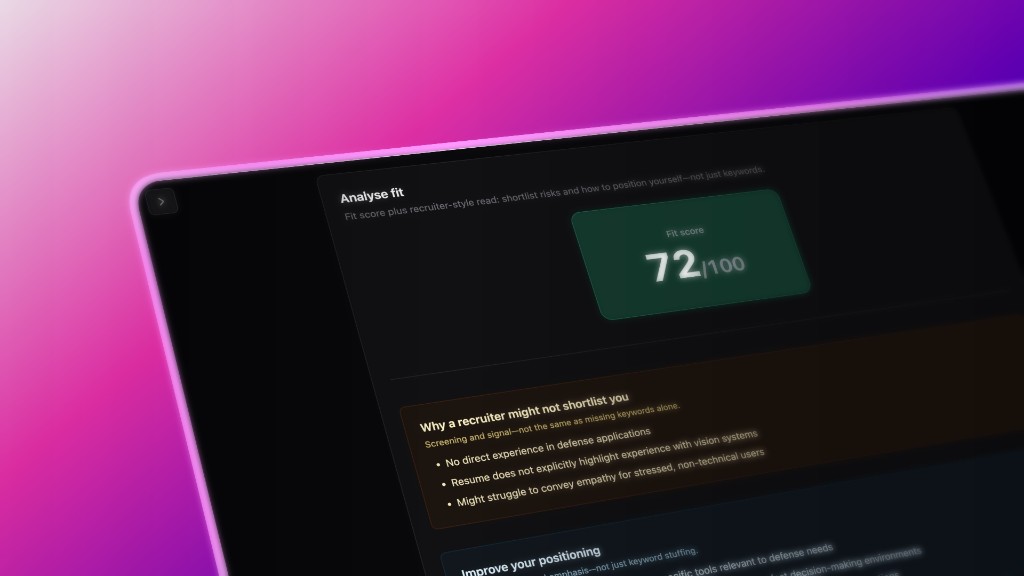
Paste in a job description. The AI breaks it down — required skills, preferred qualifications, seniority signals, team context — and cross-references it against your profile. You get a fit score, a gap analysis, and specific recommendations on how to reposition your experience for that role.
But the fit score is the least interesting part. What sits below it is what matters — a recruiter-style risk assessment that tells you specifically why you might not get shortlisted, not just which keywords you're missing. "Resume does not explicitly highlight experience with vision systems" is more useful than "vision systems: not found."
Then it flips. An "Improve your positioning" section gives you story and framing advice, not keyword stuffing instructions. The difference between "add the word vision systems to your resume" and "highlight any experience applicable to high-stakes, fast decision-making environments" is the difference between an ATS hack and actual positioning work.
Not generic advice. Role-specific, JD-grounded output that tells you what to emphasise, what to address, and what to leave out.
The thinking behind it
I built this during my own job search. I was applying to 30+ roles across PM, Product Ops, and AI-adjacent positions — each with a different framing, different vocabulary, different priorities. Manually doing a fit analysis for every role was taking longer than writing the application itself.
The tool started as a personal shortcut. It turned into something more useful — a way to be honest with yourself about fit before you invest time in an application, and a way to sharpen your positioning when the fit is close but not obvious.
What makes it different
Most AI job tools help you write better. This one helps you think better — about which roles are worth your time, how to frame your experience for a specific context, and where you genuinely need to close a gap versus where you just need to tell your story differently.
The output isn't a polished resume. It's a mirror — an honest read of how a recruiter would see your profile against this specific role, before you hit send. That's the gap most job search tools don't fill, because it's harder to build and less comfortable to read.
Why it matters
For anyone navigating a job search across multiple role types or industries, clarity is the actual bottleneck. Not the writing. The thinking before the writing. Job Fit Analyser is built for that moment — between reading a JD and deciding whether and how to apply — where most candidates either skip the hard thinking or do it badly under pressure.
A tool that does that thinking with you, grounded in the actual JD, changes the quality of every application that follows.