Technologies
India's FMCG distribution networks run on WhatsApp messages, Excel sheets, and phone calls. A stockist in Surat doesn't know what the CNF agent in Ahmedabad dispatched yesterday. A distributor places an order and waits two days for confirmation. A field rep checks in on paper. Nobody has a single view of what's actually moving through the chain.
FieldOps is a distribution management platform built for the way Indian FMCG supply chains actually work — multi-tier, relationship-driven, and operationally complex in ways that generic ERP software was never designed to handle.
The problem it solves
A typical FMCG distribution chain moves through five layers: Company → CNF Agent → Super Stockist → Distributor → Retailer. Each layer has its own people, its own stock, its own orders, and its own visibility gaps. The company at the top can see what left the warehouse. It usually has no reliable picture of what's sitting at DB level, what a retailer actually has on shelf, or where an order got stuck.
FieldOps gives every stakeholder in that chain a role-appropriate view of the same live data — so a Company Admin sees the full pipeline, a CNF Agent sees their dispatch queue, a Distributor sees their incoming orders, and a Field Employee sees their beat plan and attendance. Same system, same data, different lenses.
What it does
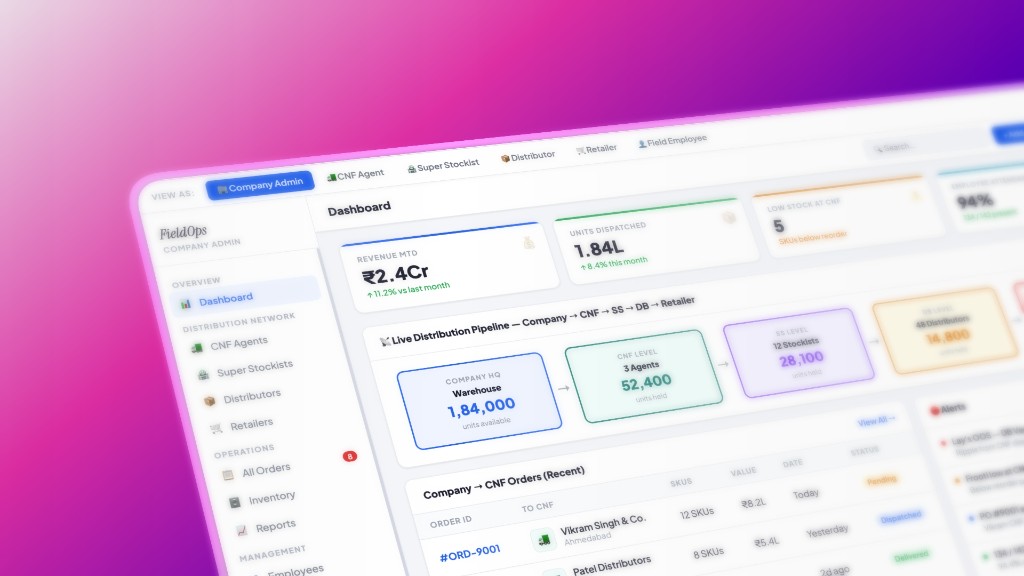
The live distribution pipeline view shows units flowing across all five tiers in real time — warehouse stock, CNF holdings, stockist inventory, distributor levels, and retailer shelf stock — in a single dashboard. No more calling down the chain to find out where a shipment is.
The alerts layer surfaces what needs attention before it becomes a problem. A retailer going out of stock triggers a ripple alert upstream. A CNF dispatch delay flags automatically. A pending purchase order sitting unapproved surfaces in the feed with context — not just a notification, but enough information to act on it immediately.
Role-based access means every user sees exactly what's relevant to their job. A field employee checking in doesn't see revenue data. A company admin sees everything — revenue MTD, units dispatched, low stock SKUs, employee attendance, recent orders, and live alerts — in one view without switching tools.
What I built
A multi-role prototype with six distinct user personas — Company Admin, CNF Agent, Super Stockist, Distributor, Retailer, and Field Employee — each with a tailored dashboard and permission set. The live distribution pipeline visualises unit flow across all five tiers simultaneously. The order management layer tracks status from placement to delivery. The alerts system flags cascading supply issues with upstream context so the right person can act, not just be informed.
The thinking behind it
This came directly from my time at Neome.ai, where I worked with FMCG and manufacturing clients trying to plug workflow gaps with automation tools. The same problems kept surfacing — visibility across tiers, order confirmation delays, field attendance tracking, stock alerts that arrived too late to act on.
Most of the solutions in the market are either too heavy (SAP-level ERP that takes 18 months to implement) or too light (a WhatsApp bot that tells you yesterday's stock). FieldOps is designed for the middle — a product that a CNF agent in a tier-2 city can actually use on day one, and that gives a Company Admin the operational picture they've been building in Excel for years.
Why it matters
Distribution is where FMCG margins are made or lost. A stockout at the retailer level that could have been caught two tiers up is not just lost revenue — it's a gap that a competitor fills. The companies that win in Indian FMCG are the ones with the best ground-level visibility, and right now most of them are running that visibility on gut feel and group chats.
FieldOps is what that visibility looks like when it's actually built.